Tokenised Stocks Won’t Trade Where You Think

Upfront disclosure: I can’t claim to be a neutral observer here. I’ll leave it at that for now, and you’ll see why by the end.
Crypto finally has an honest map of its own market structure. Timon drew it a few weeks back in the best market-structure piece this industry has produced in a while, and the shape of it holds: no single onchain trading design wins. Liquidity flowed to propAMMs and RFQ because that’s where professional market makers set the price, while the long tail stayed with plain AMMs. Batch auctions are still waiting for the patient size they were built for, and the biggest capture happens one layer up, in the routers and wallets that own the users. The point that stayed with me came at the end: nobody can measure what any of this execution costs, because the people holding the data earn more by keeping it dark.
I think the map is right. But a map only shows the territory that’s been settled, and this one ends at the edge of the flow that already lives onchain. Everyone in this industry claims a different kind of flow is on its way: issuer flow, meaning tokenised equities, funds, treasuries, and the institutions that want to trade them. That flow appears nowhere on the map, and it can’t use most of the venues. So when you ask where flow like that trades in traditional markets today, you get an answer that would bother anyone who assumes the order book is the endgame, because it mostly doesn’t trade on exchanges.
The Blank Region on the Map
The map sorts every venue design by two questions: who sets your price, and how fresh it is. Every design on it competes for flow that’s already here: retail swaps, arbitrage, whales rotating majors. Issuer flow is different, and it’s different in three ways that matter.
First, it starts from zero: a newly tokenised stock has no incumbent liquidity and no onchain price history, so no market maker has a reason to rest capital in it before demand exists.
Second, it arrives with rules attached. A tokenised equity is not a meme coin with a ticker that happens to say TSLA. Depending on the issuer, it’s a bearer-style wrapper you can hold without identification, a token whose dividends and redemption rights activate only in a verified wallet, or a fully registered security where transfers to non-whitelisted addresses revert. Those rules come from the issuer’s regulator and charter, not from the venue, and they are not always optional.
Third, the natural counterparties who trade in size are allergic to being seen doing it.
Now look at the numbers. Tokenised equities held roughly $2.4bn in onchain value as of mid-August 2026, per rwa.xyz. Solana carries over 95% of onchain tokenised-stock volume and cleared about $5.8bn of it in the second quarter of 2026 alone, which is less than QQQ trades before lunch on an average Tuesday. xStocks, meanwhile, has done more than $35bn in total volume by its own count. But the bulk of it matched on Kraken and Bybit’s centralised order books rather than onchain. The assets and the listings exist; the onchain market mostly doesn’t. Spreads are wide, books are thin, and the whole structure leans on a handful of market makers whose arbitrage maintains the peg. That isn’t quite a market yet, more inventory with a price feed.
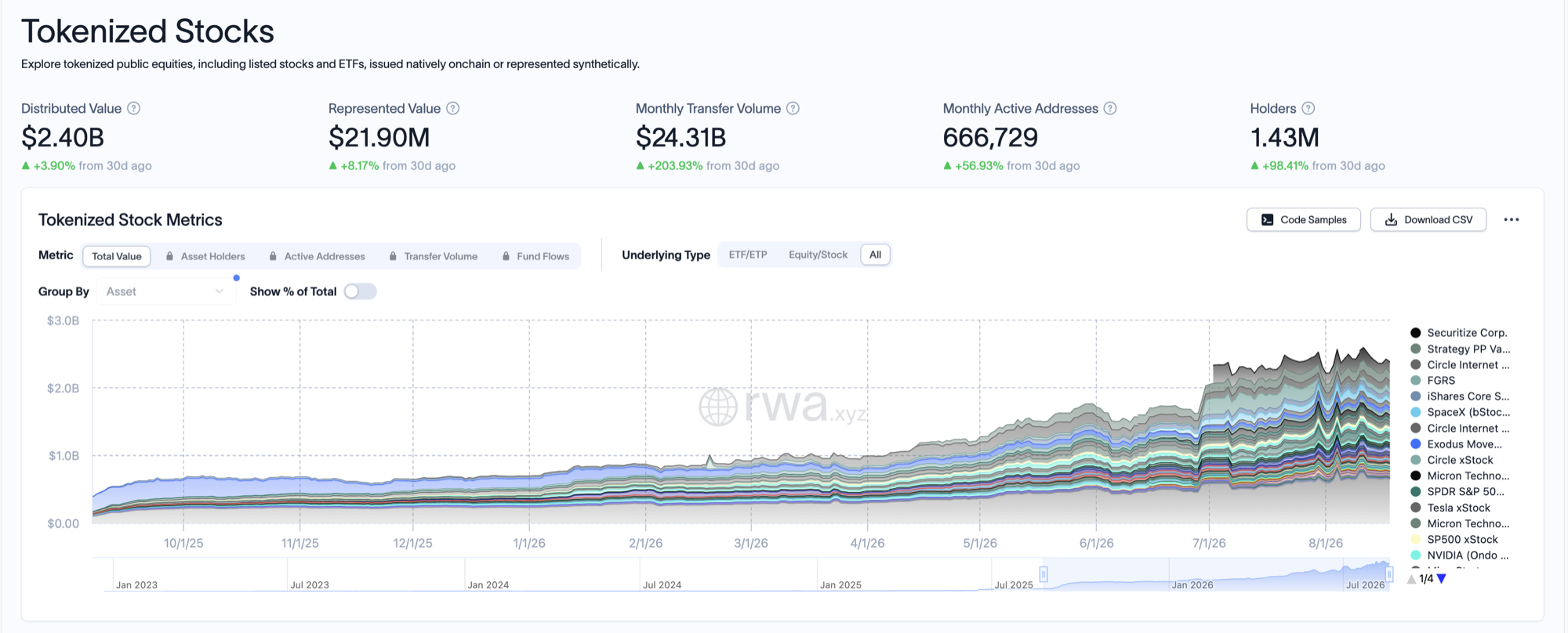
Tokenized Stocks: distributed value ~2.4B plus the growth chart. Source: app.rwa.xyz/stocks
The standard response is patience: liquidity begets liquidity; give it time. Maybe. But there’s a better guide available. Traditional finance has been trading exactly this kind of instrument for decades: thin, rule-bound, traded in size. It settled on an answer, and the answer wasn’t an order book.
What TradFi Does With This Flow
Three data points carry this section, all of them boring, all of them important.
- Start with US equities, where the off-exchange share crossed 50% of volume in early 2025 and has stayed around half since, split between dark pools, internalisers, and blocks negotiated upstairs and printed to the tape. The most liquid equity market on earth conducts half its business away from the lit book.
- European ETFs are the closest thing TradFi has to a tokenised wrapper; a fund share’s depth lives in the primary market, not the secondary book. How they trade settles the question. Bloomberg and Tradeweb, two RFQ platforms, carry about 57% of trading in the main European listings between them, while the lit exchanges carry around 22%. Institutions ask a set of dealers for a price on their exact trade and take the best answer; the order book is the minority venue.
- Then there are corporate bonds, hundreds of thousands of instruments, most of which don’t trade on a given day. Over 60% of credit volume on MarketAxess executes via disclosed RFQ, and electronic trading in US investment grade is approaching half the market. Nobody runs the long tail of CUSIPs on a central book, because there are too many instruments and not enough continuous interest in each one.
The pattern generalises, and the economics explain why. Resting a quote on a thin instrument is a standing offer to be picked off by anyone better informed; that’s adverse selection, and it’s why passive AMM LPs bleed to arbitrage. A dealer answering an RFQ prices your specific trade, at your specific size, right now, and can decline flow that seems toxic. If an order book is a broadcast, an RFQ is a phone call. When instruments are many, trading is episodic, and size is sensitive, the phone call wins.
There’s a second, less appreciated piece: TradFi doesn’t launch instruments into order books either. New ETFs get lead market makers with obligations, new listings get designated market makers, and new bond issues get allocated by dealers who then make the secondary market. The lit book is where instruments graduate once two-sided interest exists.
Demand Discovery Comes Before Price Discovery
This is the frame I keep coming back to, and it’s why I don’t read RFQ and order books as competitors.
An order book does price discovery, and does it brilliantly, when continuous two-sided flow already exists. Hyperliquid is the proof: the deepest book onchain by a wide margin, around $6bn a day and the largest share of open interest, spreads on the crypto majors that embarrass most centralised venues. On liquid instruments, the book wins; the data says so, and I have no quarrel with it.
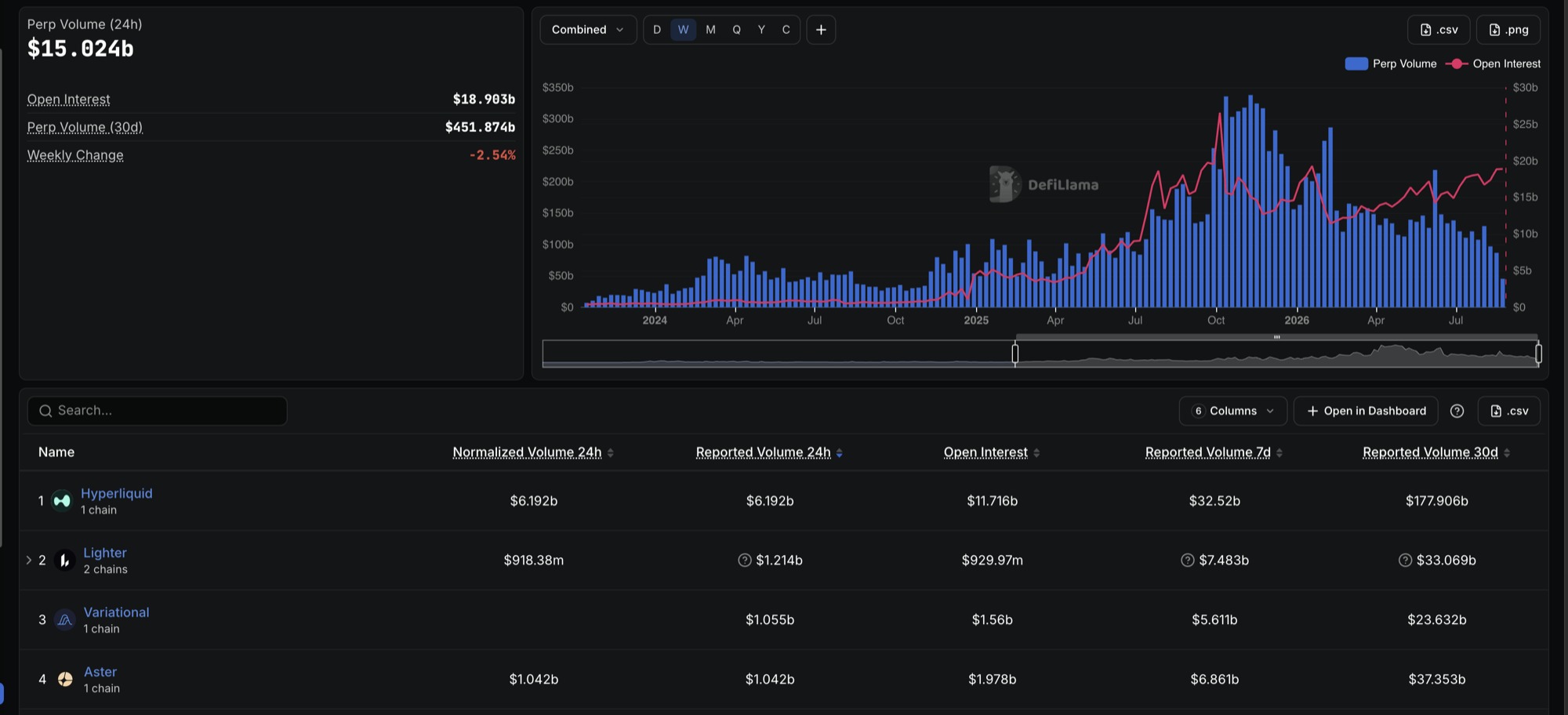
Perps: Hyperliquid #1 by open interest (~11.7B), about 6x its nearest rival. Source: defillama.com/perps
Now put yourself in the issuer’s chair. Backed’s xStocks catalogue crossed 700 tokenised assets in August, from 60 a year ago, and Dinari lists tokenised equities as an SEC-registered transfer agent. Say you want all of them tradable onchain. Launching hundreds of order books means funding the needed depth in each one before you know which tickers anyone wants. That’s an expensive way to learn that onchain demand for your 400th ticker is zero, and the failed books are public: a dead order book is negative marketing that updates in real time.
RFQs invert this cost structure. Market makers rest nothing; they quote on request from inventory they already had access to, and one maker can cover many tickers that way because a quote costs nothing until someone asks for it. An issuer’s entire catalogue becomes quotable on day one, and every request is a demand signal for a specific ticker at a specific size for its underlying. The tickers that light up deservedly graduate to an order book carrying proven volume, and the makers who’ve been quoting them already know the flow. The book gets a listing that arrives with demand attached instead of a cold start.
Demand discovery first, price discovery second. TradFi runs this sequence so routinely nobody names it; onchain has mostly been running it backwards.
This August it finally ran forwards, and you could watch it happen. xStocks arrived on Hyperliquid with native spot books on HyperCore, and it brought five tickers, not seven hundred: NVDAx, SPYx, QQQx, SKHYx and MUx, the names its centralised tape had already proven. That tape exists because an exchange like Kraken can pay the discovery bill for the head of its catalogue, cross-subsidising the market making from everything else it runs; nobody pays that bill seven hundred times, on either kind of rail. Volume did what young books do when the demand is already there, $200k a day became $500k became $1m inside the first ten days, and MUx and SKHYx now sit among the venue’s most traded spot assets. The team’s own framing is the tell: they call the spot listings complementary to HIP-3 perps, the leg that lets traders run basis and delta-neutral strategies against the futures. xStocks ran demand discovery on centralised rails, sent five graduates to the book, and the rest of the catalogue still waits for a venue that can quote it on request without funding a single resting order.
The Rulebook Problem
Cold starts are only half the issuer’s problem. The other half is that every issuer carries a different rulebook, and current onchain venues can’t read any of them.
The spectrum I described above, from bare wrapper through rights-if-verified to name-in-register, is a real product decision that every issuer has already made differently. The issuers themselves can’t agree on the canonical wrapper, and the smart ones have stopped trying: nobody knows which point on that spectrum users want, so maybe we should stop arguing about it and let the market say what it wants?
Okay, let the market decide, but none of the existing venue designs can serve that spectrum. An AMM pool can’t check anyone’s papers. Neither can a permissionless order book (and it shouldn’t, by the way); permissionlessness is its whole virtue. But that leaves issuer assets with a bad menu: trade the stripped-down bearer version everywhere, or trade the full-rights version almost nowhere.
RFQ dissolves the problem almost by accident, because RFQ participation is permissioned by nature. Makers are onboarded, takers request, and the venue sits in the middle of every trade anyway so that it can ask one more question before settlement: does this wallet satisfy the issuer’s policy for this asset? Not the venue’s policy, the issuer’s.
The plumbing for that question already runs in production today: programmable policy checks that execute before a transaction settles, with the verdict attested and enforced at the contract level. Institutions are already trading behind exactly this kind of gate. The design that matters is the neutrality. The issuer defines the policy, the trader carries their own credentials, since a KYC done once with the issuer travels with the wallet, and the venue holds everyone to the rules they each brought. The policy engine takes no side; it never touches a document, it just reads a yes or a no.
Whether institutions show up for this is the honest open question; the industry has promised patient flow to new venue designs before and watched it not arrive. What I can say is that the stated blocker, “we can’t trade where we can’t enforce our obligations,” is an engineering problem now, not a structural one.
What the Venue Would Have to Be
So let’s picture the venue this flow needs, and let me be clear: it’s not a thought experiment anymore; every piece I’m about to describe already exists in production somewhere. Let me be concrete enough to be falsifiable, because the design was never the hard part.
It would run as one RFQ system on Hyperliquid, with the chains (HyperCore & HyperEVM) abstracted away so the trader sees none of the seams. The choice is reasoned, not tribal: the deepest onchain book, the HIP-3 long tail this design serves, and atomic settlement already live there. The interesting surface is the issuer one. Wire the request straight into the issuer’s mint and redeem functions, and when a taker asks for size, competing makers can quote from primary capacity as well as inventory, minting or redeeming with the issuer inside the settlement. Tradable depth becomes whatever the issuer can create, rather than whatever happens to be sitting in a pool. That authorised-participant structure makes TradFi assets onchain liquid, rebuilt as an atomic transaction. Spot would settle the same way, atomically against funded balances. Perps, including HIP-3 markets, deserve their own section below.
The parts a finance reader judges would sit underneath the pitch. The taker’s request opens an auction window measured in seconds, makers respond with competing quotes carrying their own short expiries, and they update as the market moves. A quote like that ages in seconds, not minutes, because it never rests. Takers never see which maker is quoting them, so dealers compete without leaking their book. Makers keep a last look, but the counterweight is structural: a failed delivery fails the trade and the taker’s margin comes back untouched, never left eating a phantom fill.
Now run it back through the two questions that decide any venue: who sets your price and how fresh is it. Here, competing professional dealers set the price, trade by trade. It’s seconds old too because it’s quoted on demand. Both boxes ticked. The fee you can’t see, the one the router layer below puts numbers on, becomes a single all-in quote here: a bill you can read before you accept it.
Why RFQ Next to the Best Book Onchain
The obvious objection is that Hyperliquid already has the deepest book in DeFi, so why do you need a dealer market next to it? For BTC and ETH perps at retail size, nobody; I said as much above. But the third property I flagged at the top, size that hates being seen, is not unique to issuer assets. Those are spot, the tokenised share itself. The same problem shows up in a different instrument, the perpetual, where you trade the price of the underlying rather than the share.
HIP-3 made this concrete. Since builder-deployed markets went live in October 2025, anyone staking 500k HYPE can launch a perp market on equities, commodities, whatever an oracle can price. Open interest across HIP-3 markets passed $4.2bn by mid-August 2026, and it now runs more than half of all Hyperliquid perp volume on a 30-day average, on its busiest days taking three-quarters of it. That’s a long tail of hundreds of markets with real open interest and thinner books than the crypto majors, which is what long tails look like.
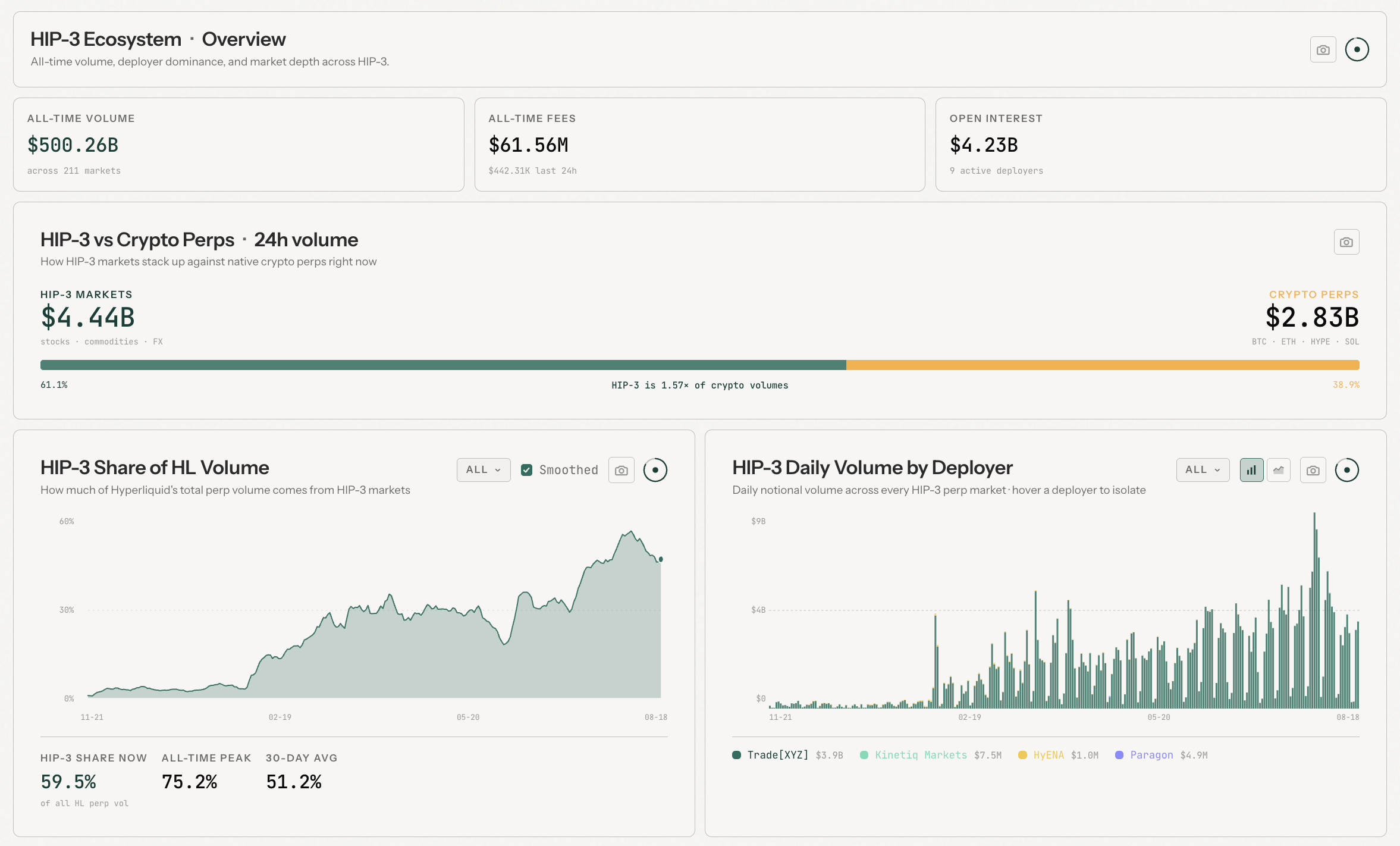
HIP-3: ecosystem totals and the HIP-3-vs-crypto-perps bar. Source: hl.eco/hip-3
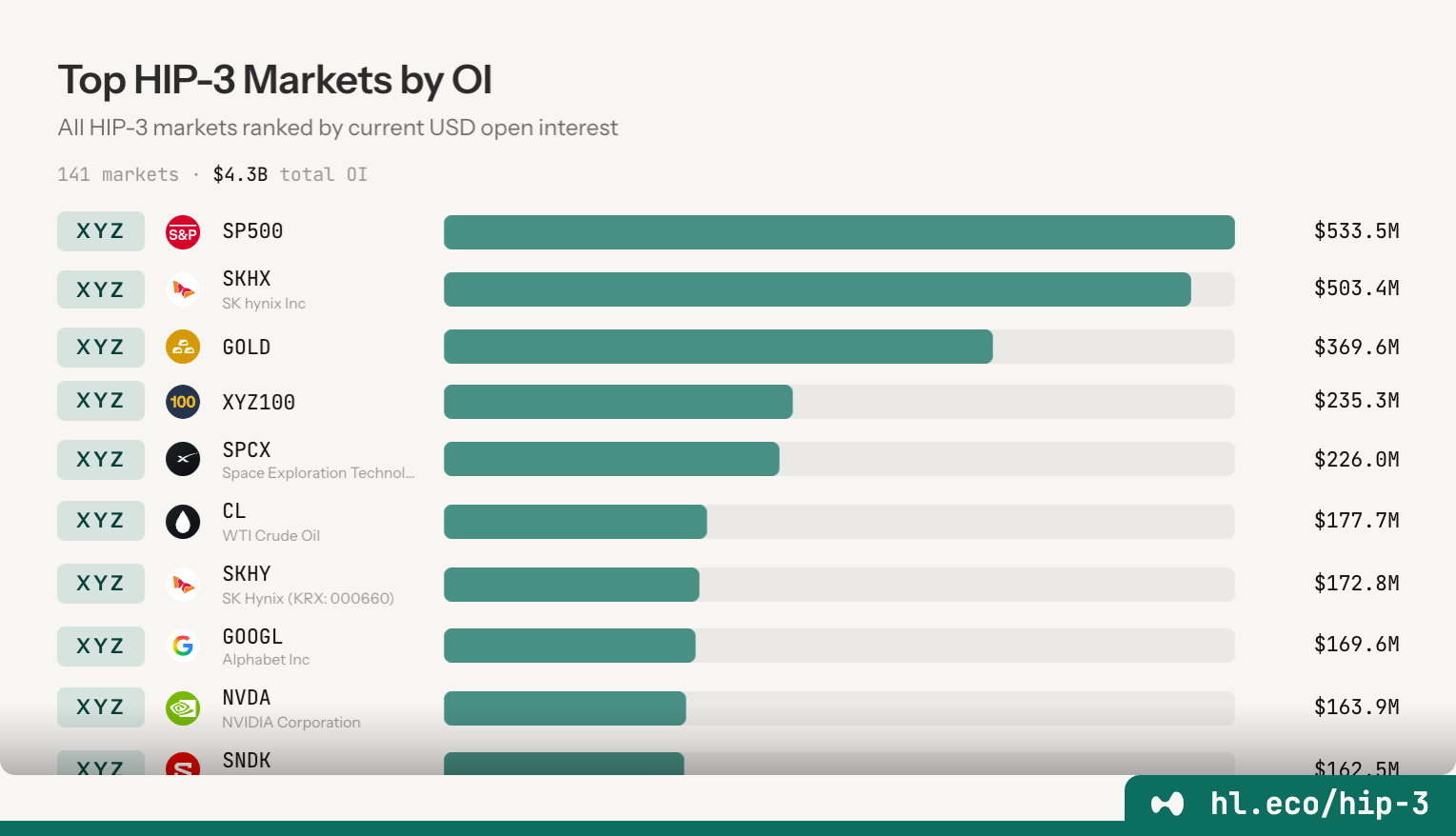
Top HIP-3 markets by open interest, tokenized equities and commodities, not crypto pairs. Source: hl.eco/hip-3
By now the problem’s obvious: on a visible book, size is information the market front-runs into an expensive fill. Equities fixed this a long time ago by moving big trades off the public book: participants agree the block privately, then report it once it’s done.
Matched execution is the onchain version of that private block trade. It delivers the block without a separate venue to hide in, using Hyperliquid’s own order book as the settlement rail instead of the thing you’re hiding from. You can’t open a HyperCore perp position except through the order book, so a venue built for this would choreograph the book rather than bypass it. A taker requests, a maker quotes, and on acceptance both pre-signed orders go into the Hyperliquid book at once, priced to cross against each other inside the spread. The taker’s margin commits when the request opens, and the maker’s margin is checked and simulated before anything touches the book. That’s what would make the fill close to deterministic rather than hopeful. Plain version: the two matching orders hit the book at the same instant, pre-priced to cross against each other unless the book can beat the price, so the trade is done before the market can react.
As a taker, I’d want to know that the book can act as a price-improvement backstop. If the maker’s quote sits outside the current spread, the taker’s order fills against the book’s better prices first, and only the remainder crosses with the maker; anything left over is cancelled rather than left resting. You cannot do worse than the book you can see, and for size you avoid walking it. The position lands in each party’s own wallet; the venue custodies nothing. This is fundamentally different from what the spot-side RFQ is serving, but the goal is the same.
The result is deliberately symbiotic: every RFQ perp fill prints as Hyperliquid volume, executed through the same book. The block trades without moving the market or announcing itself in advance and, by design, protects both parties.
Back to the Routers
The sharpest section of Timon’s piece was about the layer above all the venues: routers and wallets decide where orders go before any venue sees them, and some pricing sources game that decision. Publish an attractive quote to win the route simulation, reprice worse in the final slice of the block, and let the user’s own slippage tolerance eat the difference. His numbers put it at 3 to 10 basis points per trade, with the honest aggregators trapped displaying quotes that won’t settle, because blocking the cheaters makes your screen look worse.
The structural fix for quote fade already exists: the firm quote. A signed, fixed-price, expiry-bound order cannot reprice in the last sliver of a block; the price you accepted either settles or the whole trade fails, and there is no slippage tolerance to eat because there is no slippage. So aggregators treat RFQ-style liquidity as first-class where they can get it: a signed quote gives their users a guaranteed price and immunity to sandwiching that no simulated route can promise.
It also cuts the other way, which I suspect gets underrated. An RFQ venue doesn’t have to win the front-end war described above to reach takers, because it can export its quote surface outward to aggregators and wallets where the flow already lives, with the venue’s makers filling one hop behind. The venue that quotes firm prices travels well precisely because a router can trust it. In time, that’s the distribution story for issuer assets too: integrate once where the makers are, and become quotable wherever the routers reach.
The Uncomfortable Question, From the Issuer Side
Hanging over all of this is an uncomfortable question: if the endgame is professional market makers on fast rails, what have we actually built that TradFi doesn’t have? RFQ is decades old. Market making is older. For a trader swapping BTC, the question stings. For an issuer, the answer is concrete: getting a new security into TradFi’s dealer infrastructure takes a listing venue, a transfer agent, clearing membership, settlement plumbing, and a year of intermediaries, each taking a cut. Onchain, the trade settles whole or fails whole, custody stays with the holder, and it’s composable from day one. The rails are better. The venue design was the missing piece.
Where Better Rails Pay Off: Margin
Better rails matter most where the old ones fail outright, and for issuer assets, that’s collateral. A listing on its own does nothing for an issuer; the utility everyone asks about first is margin, the ability to borrow against the token, run the basis trade, and post it as collateral. The demand is visible already, with xStocks landing on Aave and Etherfi as collateral in the same August push that took it to Hyperliquid.
But a lending market can only accept collateral it can liquidate, and a liquidation is just a block trade on a deadline, the worst possible order to work through a thin book. A liquidator who knows that won’t underwrite size, so the collateral never gets margined in the first place. An RFQ wired into the issuer’s mint and redeem changes that arithmetic, because the liquidation exit becomes the primary market itself, quoted on demand, in size, settling to stablecoin. Lending against tokenised equity stops being a bet on secondary depth. It becomes a claim on the issuer’s redemption capacity while the underlying market is open, which no lit book can offer, because no lit book can mint. And where an issuer’s rulebook requires verified liquidators, the same policy engine gates them like any other counterparty. Margin is where tokenised assets become interesting to hold; a dealer market with a redemption line is what makes them safe to lend against.
The Scoreboard, Finally
The missing scoreboard, the execution cost nobody can measure, is where this all lands, so let me close near it. An RFQ venue that settles on Hyperliquid would be the most measurable dealer market ever built. Every fill is public, and realised spread against any reference price is checkable by anyone with a block explorer, including people who dislike you. CoW Protocol got graded on its execution quality by outsiders only because its settlement data was open enough to allow it, and that cuts both ways: the transparent venue is the one that gets graded, and for anything courting institutions, that auditability is the product. Whoever builds this should expect to be graded on exactly this, and should welcome it. I’m not neutral about where this goes, which is exactly why I’d rather be graded on a public tape than believed.
Where This Goes
I can see two futures from here. Future one: tokenised equities stay a rounding error onchain, institutions keep watching from the shore, and everything above is a well-argued answer to a question nobody asked. I can’t rule it out; the cold-start problem is real, and “traditional demand will simply arrive onchain” has been wrong before.
In future two, demand stops waiting. It’s already visible everywhere it’s allowed to be: in the $35bn of tokenised-stock volume done mostly on centralised books, in the HIP-3 perps that now take more than half of Hyperliquid’s volume, and in five tokenised stocks doing their first $1m days on Hyperliquid spot. Give it onchain venues shaped like the flow, instead of venues the flow must be reshaped for, and I don’t think the first tokenised asset to do real size onchain will do it on a lit book. It will do it the way size has always traded, in every market that ever had any: on request, from a dealer, at a price quoted for that trade and no other. And then, with demand proven, it will graduate to the book.
That’s the sequence TradFi has been running since before any of us were born. The only new part is that this time we have better settlement rails, and the venue shaped exactly like this flow is closer than you think. And the disclosure I owed you from the top: I’m not watching this one from the shore. We’ve already been building it. More on that soon.